The Idols in the Machine
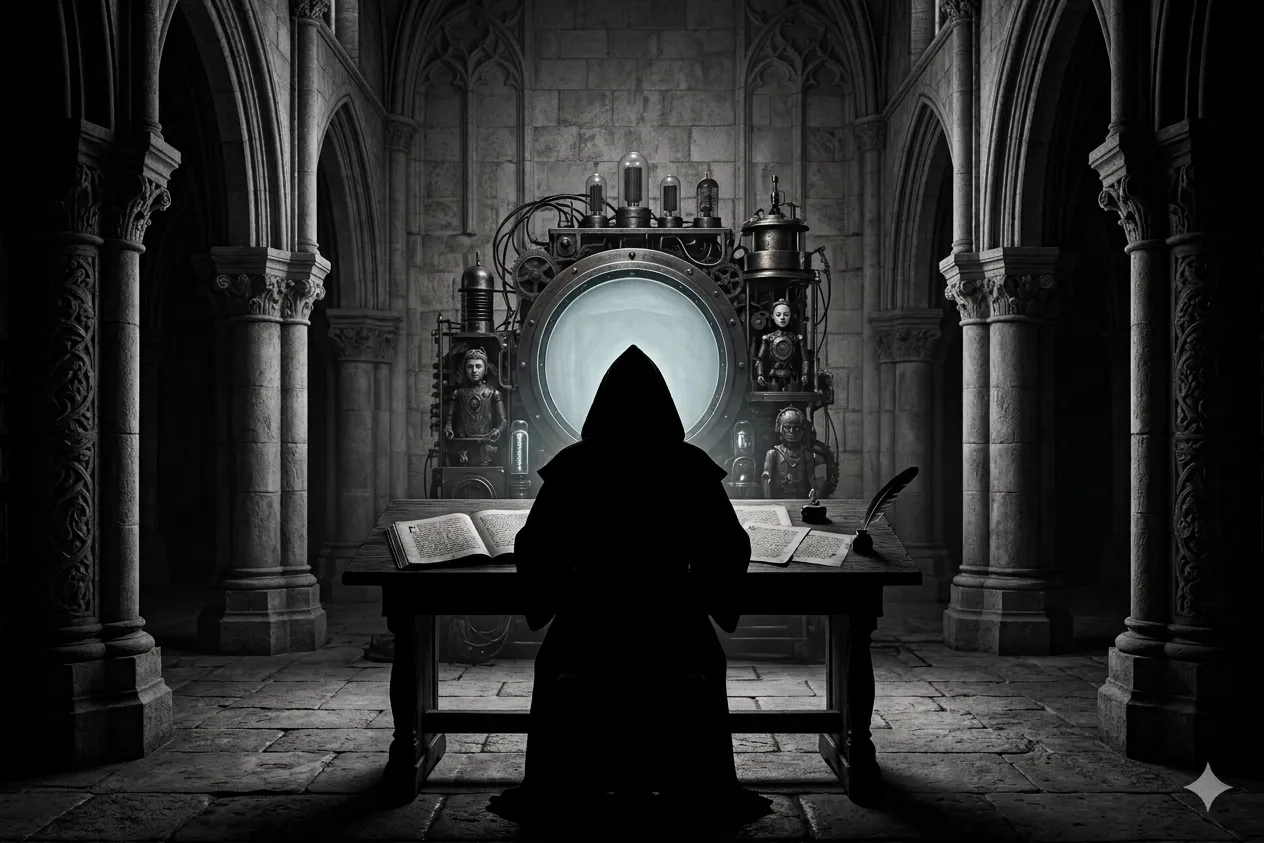
The machine finally learned to speak our language. Now the urgent skill is the oldest one: reading it closely enough not to kneel to it — the very mistake that made the last people who tried obsolete.
For fifty years the deal was simple: if you wanted to command the most powerful machines on earth, you learned to speak their language. You memorized their grammar, which was unforgiving, and their vocabulary, which was ugly, and you were rewarded handsomely for the indignity. Meanwhile, across the campus, the art majors read novels and were gently pitied. Everyone agreed the future belonged to the people who could talk to computers.
The future arrived, and the computers learned to talk to us.
This is, if you spent a decade mastering regular expressions, a cosmic insult. The scarce and valuable skill is no longer speaking Machine. The machine now speaks fluent, idiomatic, faintly sycophantic English. The scarce skill is speaking your own language well enough that a very large statistical parrot hands you back something worth having, which is to say, the scarce skill is language and rhetoric, the two subjects we spent the last half-century deciding were decorative. The “industry” has only just noticed this and, unable to admit it, has renamed writing as “prompt engineering”, on the theory that anything with “engineering” in the name can still be respected at a dinner party.
But composing the question was always the easy half. The hard half is what you do with the answer, because the machine has a peculiar relationship with the truth: it doesn’t have one. It produces sentences optimized to sound right, which is a different and more dangerous thing than being right. Philosophers have a technical term for speech that is indifferent to truth, and the term is bullshit, and I mean that in the scholarly sense.
We (as humanity) have, in fact, been here and done this before. We have a long and distinguished history of consulting authorities who speak with total confidence and no accountability (don’t worry, I am not about to press the hot buttons of religion). Famously, Croesus, king of Lydia, asked the oracle at Delphi whether he should march on Persia. The oracle replied that if he did, he would destroy a great empire. He marched. He destroyed a great empire. It was his. 1 2 The oracle was, as always, never wrong and never useful, which is roughly the customer-satisfaction profile of a chatbot. But the ancients did not abolish the oracle. They took its interpretation with deadly seriousness, and “deadly” is not decoration: they handed hemlock to Socrates, the very man the oracle had pronounced the wisest, for asking more questions than he answered 3. The entire burden of being right had been quietly transferred to the person doing the reading, and reading, it turned out, was hazardous work.
This is the point where the piece is supposed to become another “revenge of the humanities” 4 5 story, the one where the engineers get marched into the sea. Nope! Because we are nowhere near that. The models are not oracles you can trust and you have to audit them and build guardrails with a lot of pain, suffering and shell script. And liberal-arts graduates have plenty more to learn before they can do any of it.
What the moment actually demands is a stranger and more difficult creature: someone who can build the machine and interrogate what it says. Who has the mathematics, the logic, and the engineering to wire a model into a system that holds — the tools, the evaluation, the whole harness and shebang — and, in the same skull, the humane arts to read the output with suspicion and question it. An engineer who can apply hermeneutics to a paragraph and dialectic to an argument and notice the precise moment either one starts to lie. No degree currently graduates that person. The computer-science track quietly dropped the reading. The humanities track quietly dropped the math. And the machine now needs both at once. That is the real gap: not that the humanities are back, but that nothing on offer trains anyone for the combination this thing requires.
We have, as it happens, built that creature before. The medieval scholar. He carried the entire liberal-arts stack as a matter of course. He had the quadrivium, arithmetic and geometry and music and astronomy, which was his mathematics, and he had the trivium, grammar and logic and rhetoric, which were his arts of the word. Engineering and humanities in a single gown. He needed both, because he lived exactly where we now live: surrounded by authoritative texts he could not simply take at face value: Scripture and Aristotle (known then as “the Philosopher” the way we now say “the model”), and he built a whole technology to read and interpret them, the lectio and the glossa, the quaestio and the disputatio. I am not saying that we need to become “medieval again” (definitely not the dental care). I am merely pointing it out because there is a lesson to learn from history.
That creature became extinct, its project collapsed, and the collapse is the entire lesson. “Scholastic” is a slur now: the word for enormously clever people producing enormous volumes of subtle argument that never once touched the ground. What failed was not their intelligence. It was their epistemology, their theory of where knowledge comes from and what makes a belief warranted. They had mistaken the authority of the text for the ground of truth, and then reasoned, brilliantly, from premises they never thought to test.
When Francis Bacon finally detonated the edifice, he did it by cataloguing the idols 6, his name for the structural ways the human mind deceives itself. Read that catalogue today and the parallel to our own machine is uncanny. Bacon might as well have been writing the release notes for a large language model. That parallel deserves its own essay, and it will get one.
But those are the idols Bacon could already see. The harder question, the one the scholastics never thought to ask until it was far too late, is the one his method was really driving at:
What are the idols we cannot yet see?
What epistemological trap is this technology laying that will be obvious only to whoever comes after us, the way the scholastics’ blindness is obvious to us now? I do not know what ours is. I am certain there is one, for the plain reason that there always is. Being wrong in ways invisible to ourselves is not a medieval affliction, it is the human condition. And this is where the humanities stop being an ornament and become the instrument. Because the disciplines that train you to distrust the surface of a text, to catch a word smuggling a conclusion, to argue the other side before you trust your own, are precisely the tools for hunting an idol you cannot yet name. And, once it is named, for breaking it, the way Abraham broke the idols of his father 7. An idol, in Bacon’s sense as much as Abraham’s, is a thing we venerate that has nothing behind it. The humanities are how a civilization audits its own knowing. We will need them not to feel more human, but to keep ourselves from becoming the second scholastics: fluent, prolific, confident, and quietly, catastrophically wrong.
Footnotes
-
As I write this, the United States and Israel are at war with Iran and it is eerily similar to what Croesus went through. Thousands of Iranians died, including many children. It has become a quagmire, with the energy markets and the world economy in the balance and American credibility in free fall, all the classic symptoms of an empire in decline. ↩
-
The pious story is that Athens killed him for free inquiry. For a provocative counter-reading, see I. F. Stone, The Trial of Socrates (1988). He argues democratic Athens had a real political grievance against an anti-democratic teacher whose students, Critias and Alcibiades among them, had helped overthrow the democracy, and that Plato’s Apology has spent 2,500 years obscuring it. ↩